Bend, Don't Break: Sizing Your Bankroll to a Slot's Temperament
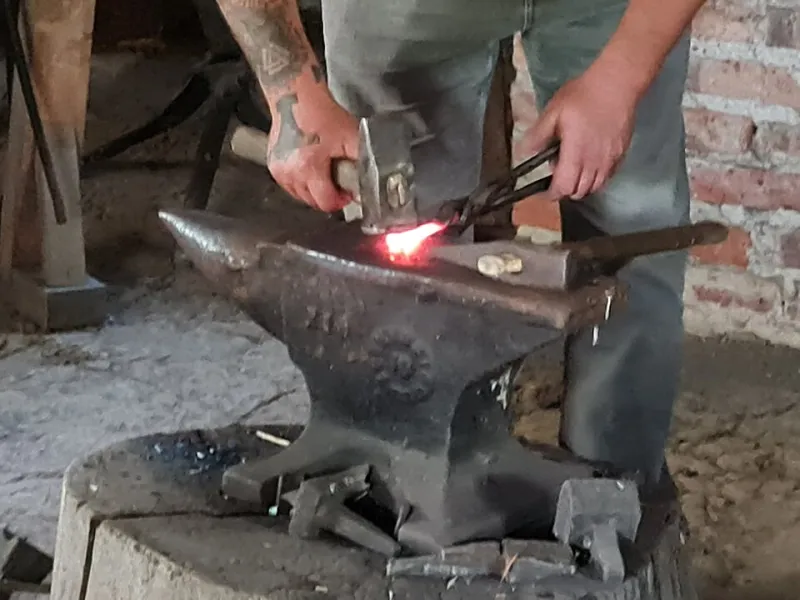
Photo: MichalPL, CC BY-SA 4.0, via Wikimedia Commons
The village blacksmith does not ask which sword is best. He asks what the sword is for, then picks the steel to match. A blade that shatters on the first swing is not a bad blade — it is a blade asked to do a job it was never forged for.
Slots work the same way. There is no best game. There is only the right temperament for your bankroll, your patience, and the amount of time you actually have.
So let's put away the rankings and pick up the tools.
The Forge: What Volatility Actually Means
Volatility is a measure of how a game distributes its payouts over time. It is not the same as return to player, and it is not the same as your odds of a good night.
- Low volatility games pay smaller amounts more often. The ride is smooth. Your balance drifts down in small steps with frequent little recoveries.
- Medium volatility games split the difference — occasional meaningful hits, quieter stretches in between.
- High volatility games pay rarely and, when they do, they pay big. The ride is a long flat line punctuated by cliffs, in both directions.
Two games can have nearly identical long-run returns and feel absolutely nothing alike. That gap is what volatility describes.
Hit Frequency Is Not Generosity
Hit frequency is the share of spins that return anything at all — even a fraction of your stake. A low-volatility game might pay something on roughly two out of every five spins. A high-volatility title might return something on one in four, or fewer.
Here is the trap: a high hit frequency feels generous, but many of those hits are smaller than your bet. A game that returns half your stake is a hit on the meter and a loss in the ledger. Conversely, a high-volatility game can feel broken for a hundred spins and then produce a single result that changes the whole session.
Neither is better. They are different tools.
Reading a Game's Temperament Before You Commit
You can usually identify a game's personality without any research at all:
- Look at the paytable. If the top symbol pays modestly and the bonus triggers often, you are looking at a low or medium temperament. If the top symbol pays hundreds of times your stake and there is a long list of multiplier mechanics, expect high.
- Look at the max win. A game advertising 5,000x your stake is a different animal from one advertising 50,000x.
- Play a small session at minimum bet. Twenty minutes of minimum-bet play tells you more than any review.
- Check the rules screen for the stated volatility and hit frequency. Many regulated US games publish both.
Sizing the Metal: A Bankroll Rule of Thumb
Here is the blacksmith's arithmetic. Bankroll size should be expressed in multiples of your bet per spin, not in dollars. Dollars lie; multiples tell the truth.
A rough starting framework for a single session:
- Low volatility: 30 to 50 times your bet. A $1 spin wants a session bankroll in the $30 to $50 range.
- Medium volatility: 60 to 100 times your bet. A $1 spin wants $60 to $100.
- High volatility: 150 to 300 times your bet. A $1 spin wants $150 to $300, and honestly, more if you want to survive the quiet stretches.
These are not guarantees. They are survival ranges — enough cushion that a normal cold streak does not end your session in four minutes. If your budget cannot cover the range for a game you want to play, the answer is not a bigger deposit. The answer is a smaller bet, or a different game.
Session Length: How Long a Blade Holds an Edge
Time is the other half of the equation. A $200 bankroll on a high-volatility game at $1 a spin is a different experience than the same $200 at $0.20 a spin.
A practical approach for US players:
- Decide the session length first. Ninety minutes is a reasonable default for an evening session.
- Estimate spins per minute. Most players land between 200 and 400 spins an hour depending on how fast they tap.
- Multiply. Ninety minutes at 300 spins an hour is 450 spins. At $1 a spin, that is $450 of handle — and your bankroll needs to survive the variance inside that window.
- Adjust the bet, not the plan. If the math does not fit your budget, lower the bet size. Never stretch the budget to fit the bet.
Matching Temperament to Budget
A short field guide, written the way the smith would say it:
- Small budget, want a long evening? Low volatility. Fewer heartbreaks, slower bleed, plenty of little hits to keep the night moving.
- Medium budget, want a shot at something memorable? Medium volatility. The middle of the road exists for a reason.
- Comfortable budget, chasing the big number? High volatility, sized properly, with the full understanding that most sessions end quietly.
- Short on time and want action? Low or medium, higher bet, shorter session. Do not buy a long blade for a quick job.
What you should not do is take a small budget into a high-volatility game at a bet size that only survives twenty minutes. That is not a strategy. That is a countdown.
A Three-Part Test Before Every Session
- What is my bankroll for tonight, in dollars? Write it down.
- What is my bet size, and how many spins does my bankroll buy at that size? If the answer is under a hundred for a high-volatility game, drop the bet.
- What is my stopping point — money and time? Set both and honor both.
The Smith's Closing Word
Good steel is not the steel that never bends. It is the steel that bends and comes back. Your bankroll should be forged the same way: sized so a bad run is uncomfortable but survivable, and matched to a game whose rhythm you can actually live with for ninety minutes.
Pick the temperament, then size the hammer. The village will still be here next week either way.